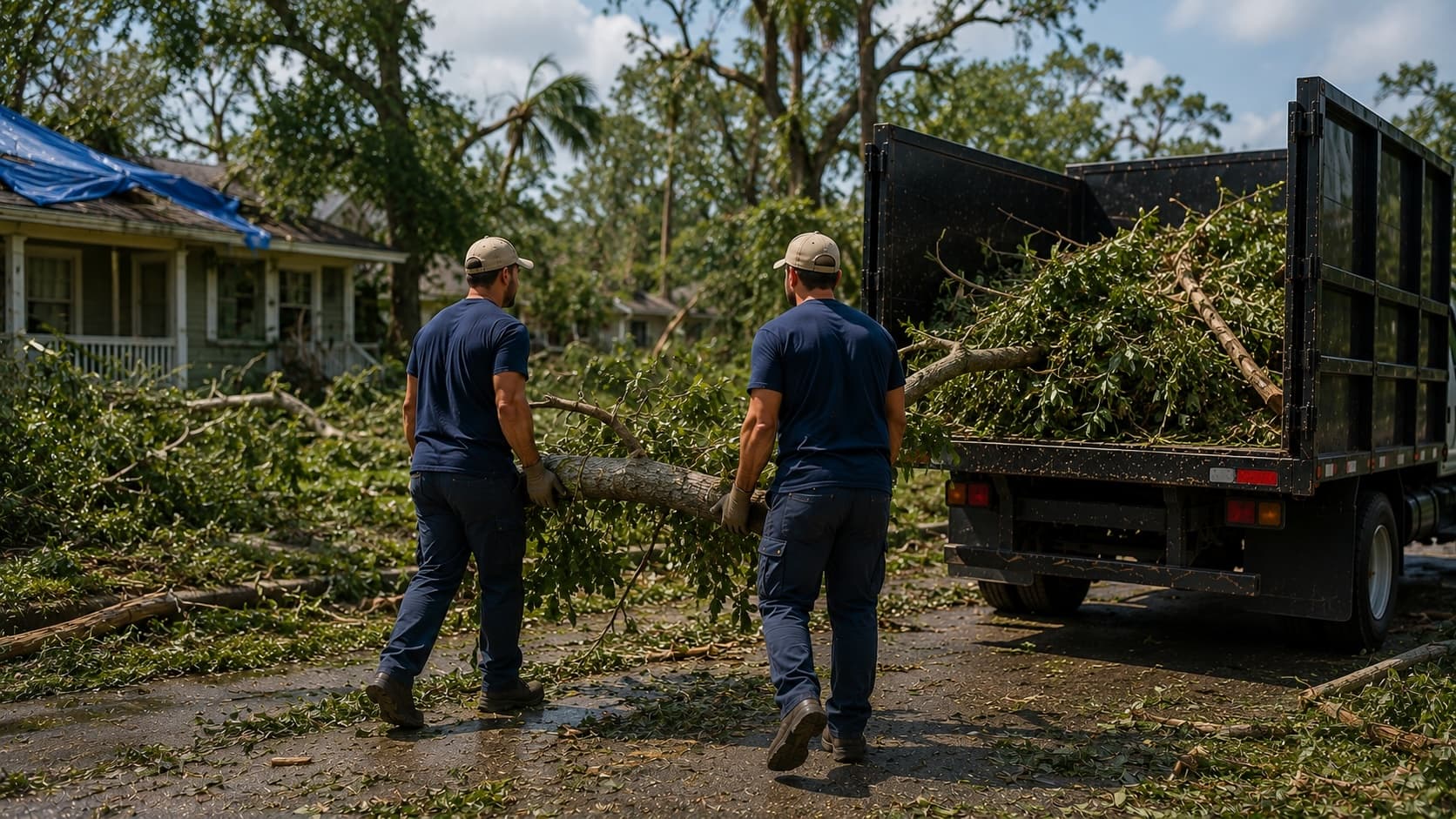
Storm Debris Still in Your Brunswick Yard?
Same-Day Storm Debris Removal in Brunswick Often Available — Call or Text
The short version
Storm & Yard Debris at a glance.
- What it is
- Post-storm and hurricane cleanup across coastal Georgia — branches, fence sections, water-damaged contents, and tarps, cleared in the waves the recovery actually runs.
- What’s included
- Fallen branches, limbs, and palm fronds
- Downed fence sections and outdoor structures
- Water-damaged furniture, carpet, and drywall
- Multi-trip scheduling at the family’s pace
- Coordination with county curbside collection
- How pricing works
- Priced by volume and weight, the same as the rest of our work — no emergency-response premium. Fully fallen trees are cut to length and hauled; leaning or upright trees need a tree service first. We tell you when the county curbside route is the cheaper path.
Hurricane cleanup is event-driven work, but it doesn’t finish in a week. The first week is tarps and emergency clearings — county crews, utility crews, and the homeowners just trying to make their houses functional. The second and third weeks are the work we run heaviest: yards full of fallen branches, fence sections leaning sideways, screened porches torn open, water-damaged furniture from flooded ground floors. The fourth and fifth weeks are the finish work — the last load, the slow yards, the families who finally have time after the immediate crisis to call somebody.
We’ve worked the cleanups across the region. The pace, the volume, and the families dealing with it aren’t abstractions to us — coastal Georgia takes hurricanes seriously, and we run this work seriously. Same-day post-storm calls are usually answered within the day; volume scheduling kicks in once the regional damage map is clear and the truck routing can be planned.
Where we do the work differently is that we don’t price storm work like commercial-grade emergency response. The customers calling us aren’t insurance adjusters; they’re neighbors. The pricing reflects what the work actually costs, not what the urgency might bear.
We should be honest about what happens to scheduling when a real storm comes through, because the alternative is promising something nobody in this region can deliver. When every property owner on the coast is looking at damage on the same morning, demand outstrips every junk-removal company, tree service and construction crew in the area combined. So we triage rather than work first-come-first-served. Genuine hazards go first — a tree through a roof, a blocked driveway somebody cannot get an ambulance up, anything structurally unsafe. Then the debris that is still causing damage while it sits, like a leaning tree resting on a fence that is about to go. Routine yard cleanup and cosmetic work comes last. It means some people wait, and we would rather tell you that than take a booking we cannot honor.
There is also a bottleneck almost nobody outside this trade thinks about until they are standing in it: disposal capacity. After a widespread storm, every crew in the region is generating debris at once and the receiving facilities simply fill up. A dump run that is normally quick can mean hours waiting in line, and some facilities reach capacity and turn trucks away entirely. The county may open temporary debris staging sites to relieve it. What that means practically is that how fast anybody can clean up is often governed not by trucks or crews but by where the material is allowed to go that day. We plan around it, and it is a large part of why post-storm timelines are given honestly rather than optimistically.
Storm debris splits between yard-waste routing, landfill, and curbside pickup if the county is running curbside collection on the schedule. We coordinate with what the county is doing so customers don’t pay for hauling that the county would have collected from the curb.
Who calls us
Who we run this work for.
Homeowners with yards full of fallen branches, palms down across fences, debris from neighbors’ trees that ended up on their property. The work runs from a quarter-truck to multi-truck loads depending on the storm track and the property’s tree cover.
Insurance-claim customers needing the debris cleared so the adjuster, the contractor, or the photographer can get to the actual damage.
HOAs and property managers after a regional storm event. Common-area cleanup at the entrance, damage to community amenities, downed trees on community walking paths. Different invoicing, often coordinated with multiple HOA decision-makers.
Homeowners with water-damaged interior loss — flood waters into ground floors, ruined carpet, sheetrock, lower cabinets, kitchen appliances. Storm cleanup blends into construction-debris work for these calls, and where the load goes depends on what is in it.
Worth being clear about the line, because water damage is where it gets crossed: we remove ordinary debris out of a damaged property. We are not a mold-remediation company and we are not a hazardous-materials contractor. Where a property has contamination, hazardous conditions, or anything that calls for regulated remediation, that belongs to a specialist who holds what that work requires, and we will say so on the walkthrough rather than after the crew is inside.
The customer who finally has time, two weeks after the storm. The immediate crisis is over, the family is back to work, and the back yard still looks like the storm just hit. That call is normal in week three. We don’t rush families through it.
How we do it
Storm Debris From the Back of a Brunswick Property
On-site walkthrough is the standard for storm work because volume is impossible to estimate over the phone after a real storm. Free, no obligation. Photos help for partial estimates, but most storm jobs benefit from a quick look.
We arrive with the hands the job needs, a truck, gloves, and chainsaws when the call says branches over six inches. Small branches, leaves, palm fronds, and yard debris go in the standard load. Larger branches get cut to truck-bed length on site. Fence sections, ruined patio furniture, and debris that landed on the property all ride in the same load.
Multi-trip jobs are scheduled in waves. First trip clears the urgent and the heaviest; subsequent trips handle the slower-paced finish work. Customers in active recovery often want the work spread across days, not pressed into a single visit. We move at the pace the family is moving.
After a blow, a yard along Highway 341 or a rural waterfront property out at Fancy Bluff can mean a long walk of limbs, fence sections and palm fronds from the back of the land to the road. Branches get cut to truck-bed length on site and everything rides in the same load. After a widespread storm, genuine hazards go first, and when the county is running curbside pickup we’ll tell you so you aren’t paying for what it would have collected. Send photos of the yard and the way in. Storm cleanup across Brunswick and the county is priced like any other job, with no emergency premium.
What’s in scope
What we haul.
What we haul in this category
- Tree branches, fallen limbs, palm fronds
- Whole trees and large limbs (cut to truck-bed length on site)
- Fence sections, downed gates, fence panels
- Storm-damaged sheds, gazebos, outdoor structures
- Water-damaged furniture from flooded ground floors
- Saturated carpet, padding, underlayment from interior flooding
- Damaged drywall, insulation, lower cabinets from water intrusion
- Storm-damaged appliances (refrigerator handling per EPA)
- Tarps, plastic sheeting, blue-tarp roof debris
- Loose roofing material, shingles, fascia, gutter sections
- Pool debris, hot tub damage, outdoor recreation equipment
- Yard debris from emergency tree work — chips, sawdust, large piles
When licensed electrical or plumbing work is needed, that’s normally handled by you or a licensed pro. Show us what you have and where it is, and we’ll help figure out what’s needed and work around it. Hazardous materials — chemicals, solvents, fuel, asbestos-suspect material and the like — need their own route, and we’ll tell you where they go. Where another professional genuinely has to be involved — a tree service, a roofer, a certified shredding provider — we’ll tell you when we quote and work around them.
Pricing
How pricing works on these jobs.
Storm-debris pricing scales with volume and weight. A quarter-truck of branches and yard debris is the lightest version. A whole-yard cleanup with fence sections, water-damaged furniture, and downed limbs is a multi-load job priced as such.
We don’t charge emergency-response premiums. Storm work is priced the same way the rest of our work is priced — volume, weight, access, disposal route. The customers calling after a storm are neighbors, not insurance carriers.
Coordination with curbside pickup matters. Some Glynn County and McIntosh County storm responses include county-funded curbside collection of yard debris on a defined schedule; we’ll tell customers when the county is planning to come through so they aren’t paying us for hauling the county would have done. Honest answers cost us a load and earn the next one.
Doing this as part of your job?
We work differently for the pros.
In this category
Items we haul under storm & yard debris.
Where we run this work
Cities where storm & yard debris runs high-volume.
Related services
Related categories you might also need.
- Dumpster Rental10, 15, 20, 30 and sometimes 40 yard roll-offs, placed where you need them. You fill it, we haul it away.
- Construction DebrisDrywall, flooring, framing, fixtures. For homeowners and GCs.
- Yard & Storm DebrisBranches, palm fronds, fence sections, and hurricane cleanup — hauled away fast.
- Light DemolitionSheds, decks, playsets, and above-ground pools — deconstructed and removed.
- Furniture & MattressesSofas, sectionals, beds, dressers. Carried out, loaded and hauled away.
- Hot Tubs & Light DemoHot tubs, spas, sheds, playsets, decks. We cut it down, we haul it out.
Questions
Frequently asked questions about storm & yard debris.
Storm Debris Removal by town: Darien · Jekyll Island · St. Simons Island
Serving Brunswick and St. Simons Island.
We are handled out of our Brunswick base, across Glynn County and the Golden Isles. Same-day pickup is often available — call or text for the next available opening.
Ready when you are
Ready to get it out of your driveway?
Get a firm price from photos. Same-day pickup often available across the Golden Isles.
Get a free estimate onlineOpen Mon–Sat 7:30am–10pm · Sunday 9am–7pm
Last reviewed: April 27, 2026