Appliance
Dehumidifier removal across the Golden Isles.
Residential dehumidifiers, commercial flood-recovery units, dead garage units. Routed to an appliance recycler that handles refrigerant recovery. Steel and copper separated at the back end.
The short version
Dehumidifier Removal at a glance.
- What it is
- Removal of dehumidifiers, with refrigerant-bearing units routed after pickup to an appliance recycler that handles recovery.
- What’s included
- Portable and whole-home dehumidifiers
- Basement and crawl-space units
- Refrigerant-bearing models handled per EPA
- Quick single-unit carry-out
- Scrap-metal recycling after refrigerant recovery
- How pricing works
- These are light, quick pickups, so price tracks access more than weight — a basement or crawl-space carry-out is the heaviest version. Often added to a larger appliance or cleanout job. Quoted after a photo.
Part of our Appliance Removal service
Dehumidifiers are the appliance most likely to die in coastal Georgia. Salt air, humidity, and constant operation wear compressors faster than the manuals predict. The unit runs four months out of the year on the inland properties and ten months out of the year on the islands; the duty cycle on a dehumidifier in Brunswick is brutal compared to anywhere with a temperate climate. Compressors that the manufacturer rated for ten years sometimes die at five.
The most common call is the failed unit replacement. The dehumidifier ran the basement, the garage, the crawl space, or the laundry room — and then it didn’t. The compressor seized, the unit stopped pulling water, and the customer is replacing it. Estate cleanouts produce dehumidifiers from basements and crawl spaces where they were forgotten years ago, sometimes still running on auto-restart cycles, sometimes dead but still plugged in. Post-storm cleanups produce them in volume — flood recovery teams run dehumidifiers continuously for weeks, and the units sometimes need disposal afterward when the rental cycle ends.
Operationally, dehumidifier removal mirrors refrigerator and freezer work. Residential dehumidifiers carry refrigerant — usually R-410a in modern units, R-134a in older ones, occasionally R-22 in pre-2010 units. EPA rules require recovery before disposal. We don’t skip that step. Standard residential units run 30 to 70 pounds, single-person carry on most floors, two-person on stairs. Commercial dehumidifiers (the rental units used during flood recovery) push past 100 pounds and use an appliance dolly.
Most customers don’t realize a dead dehumidifier carries refrigerant the same way a dead refrigerator does, which means it has the same constraint on where it can go. So it takes the same route — an appliance recycler that handles the recovery, then steel and copper separation. Coastal Georgia runs through more dehumidifiers than most places, and the units that come out of a flooded house are usually the ones people are most surprised can’t just go in the load.
What we haul
Specifically, what we take for dehumidifier removal.
- Standard residential dehumidifiers (30-70 pint capacity)
- Whole-house dehumidifiers (in-line ductwork installs, when scoped)
- Crawl-space dehumidifiers (low-profile units common in coastal homes)
- Basement dehumidifiers (high-capacity residential units)
- Commercial flood-recovery dehumidifiers (rental units past their cycle)
- Failed dehumidifiers (compressor seized, drainage failed, fan dead)
- Dehumidifiers with built-in pump systems
- Energy Star and older non-rated units
How we work
How we actually handle it.
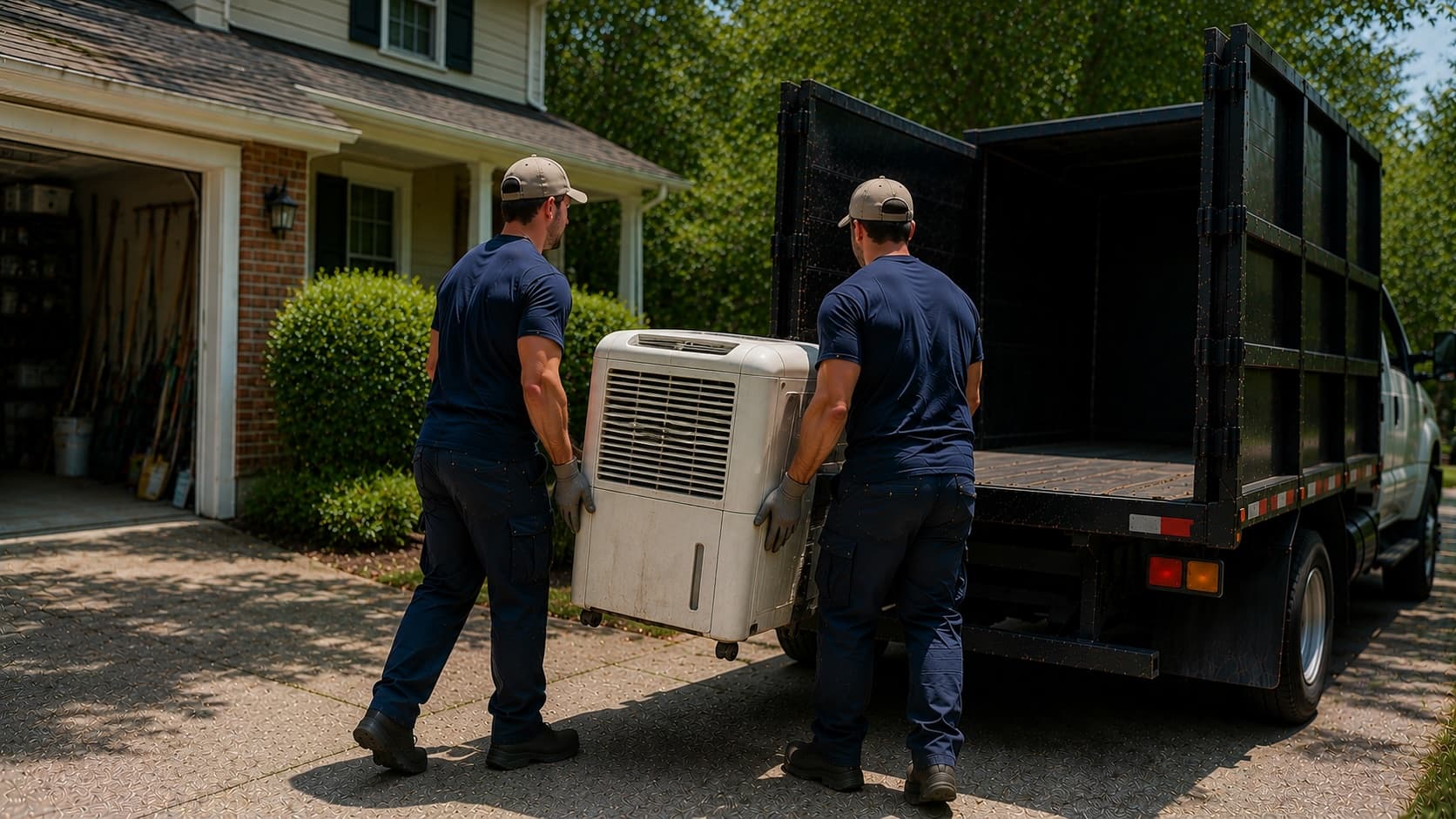
Most dehumidifier jobs run twenty to forty minutes. The collection bucket should be drained before pickup — if it isn’t, water spills during the carry-out and we mop up. Plug comes out, hose disconnects (if the unit has a continuous-drain hose), and the unit rolls or carries out depending on the size.
Standard residential dehumidifiers handle like a small chest freezer in operational terms — bottom-heavy, awkward but manageable on dollies, two-person carry on stairs. The compressor sits in the lower portion of the unit and shifts the weight low; tilting too far forward during carry-out can stress the seals on the refrigerant lines. We carry upright when possible.
Commercial dehumidifiers from flood recovery are heavier and bulkier than residential units. They’re built to run continuously for weeks at a time without overheating — that durability adds weight. They carry rather than roll, and stairs mean an appliance dolly and enough hands for the weight. Same route as residential — an appliance recycler for the refrigerant, scrap channels for the metal.
Pricing
How pricing works.
Dehumidifier pricing scales with size and access. A standard residential unit from a basement with stair access is the lightest version. A commercial flood-recovery unit from a third-floor crawl space (rare but real on some coastal multi-story properties) is the heaviest.
Phone quotes work for dehumidifier jobs. Photos help when the unit is in an unusual location (crawl space, sealed equipment closet) or when the install includes ductwork that affects removal complexity. Multi-appliance jobs (dehumidifier plus refrigerator plus freezer) cost less per unit than single-appliance pickups because the visit consolidates the disposal route.
Refrigerant recovery isn’t a line item you pay separately — you pay for the unit gone, and getting it to a facility set up to handle it is part of that.
Ready when you are
Need dehumidifier removal hauled away? We can help.
The honest exceptions
What we won’t take — for this item.
A short, honest list of edge cases we either won’t take or want to discuss before we show up. When in doubt, call us — we’ll walk through it before scheduling.
- Dehumidifiers with active visibly-leaking refrigerant — call us first to plan the protocol
- Whole-house dehumidifier removal requiring HVAC ductwork modification — that’s licensed HVAC scope first
- Commercial-scale industrial dehumidifiers exceeding two-person carry capacity without specialty equipment
- Dehumidifier repair, parts diagnostics, or salvage of working components for resale
Questions
Frequently asked questions about dehumidifier removal.
Related items
Other things people pair with this haul.
Refrigerator Removal
Refrigerator removal routes the unit to an appliance recycler that handles refrigerant recovery on its end — you don’t do anything beforehand.
Read moreFreezer Removal
Most freezer jobs run thirty to sixty minutes depending on whether the unit is empty or full.
Read moreAir Conditioner Removal
Window AC units are the simplest version.
Read moreWater Heater Removal
Water heater removal starts with the prep on the old unit.
Read moreDishwasher Removal
Most dishwasher jobs run thirty minutes start to finish.
Read moreDryer Removal
Most dryer-only jobs run thirty to forty-five minutes.
Read more
Common in
Where we haul dehumidifier removal most.
We haul dehumidifier removal regularly across the Golden Isles, especially in Brunswick, St. Simons Island, Sea Island, Jekyll Island, and Darien.

Ready when you are
Ready to get it out of your driveway?
Free quote in 60 seconds. Same-day pickup available across the Golden Isles.
Open Mon–Sat 7:30am–10pm · Sunday 9am–7pm
Last reviewed: April 27, 2026