Appliance
Water heater removal across the Golden Isles.
Tank or tankless. Drained, disconnected, hauled out. Standard 40 and 50 gallon, larger 80s, wall-mounted tankless.
The short version
Water Heater Removal at a glance.
- What it is
- Removal of tank and tankless water heaters — drained, disconnected, and hauled, then routed to scrap-metal recyclers.
- What’s included
- 40, 50, and 80-gallon tank heaters
- Tankless wall-mounted units
- Gas and electric models
- On-site draining before carry-out
- Scrap-metal recycling routing
- How pricing works
- Priced by size, type, and access — a standard tank from a garage is lightest, an 80-gallon from a basement heaviest. The gas line is capped by you or a licensed plumber/gas pro and hardwired electrical by an electrician first; we don’t do gas, plumbing, or electrical work. Quoted before we touch the unit.
Part of our Appliance Removal service
Water heater removal is the kind of appliance job where the prep work matters more than the carry. Put numbers on it and the reason is obvious: a standard fifty-gallon tank is around 150 pounds empty, and the water inside it is another 400. Drain it first — always drain it first. Without that, the unit is too heavy to handle safely and the water ends up somewhere it shouldn’t.
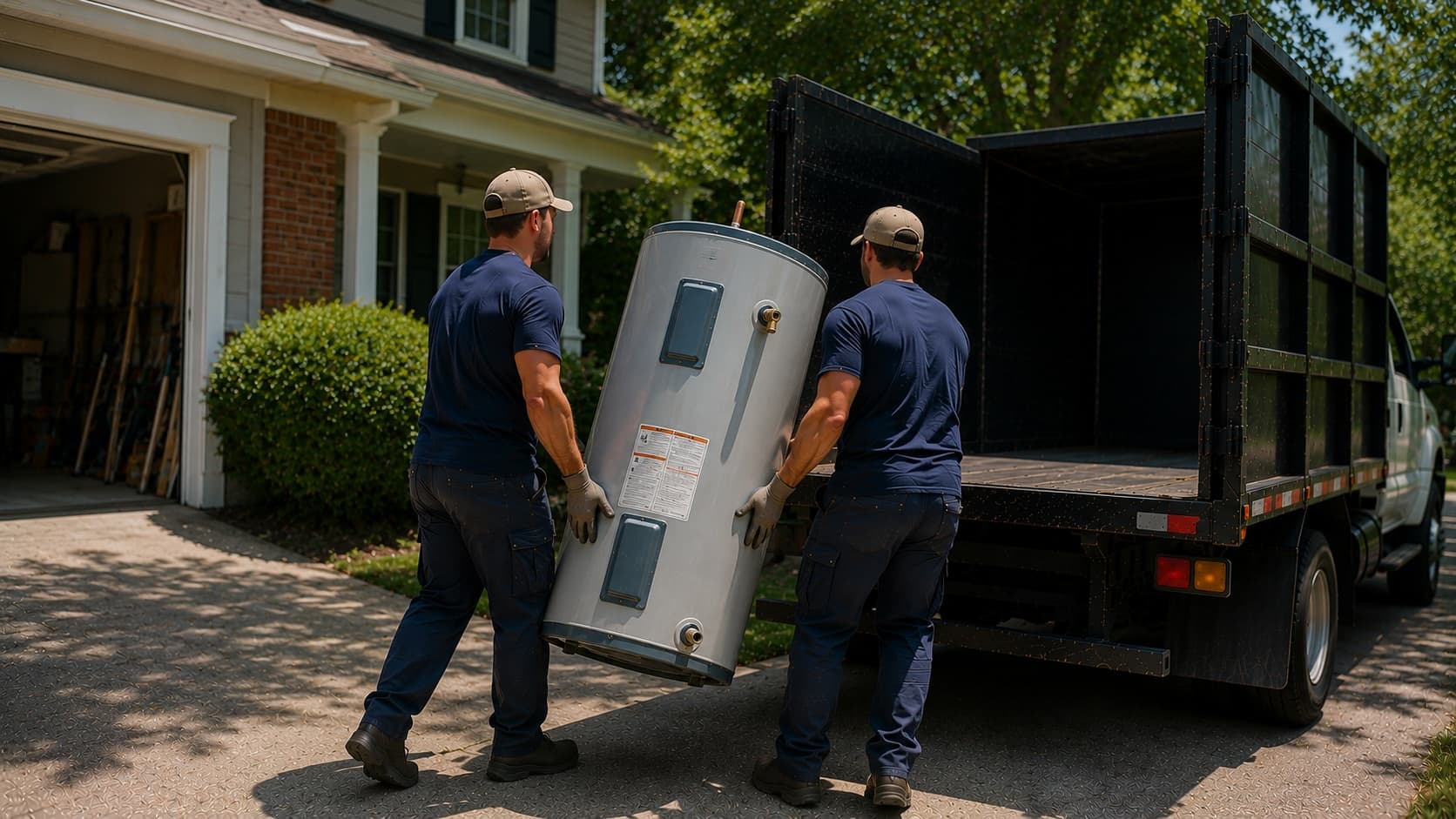
After draining the tank to a hose run, we disconnect the accessible water lines and haul the unit out. We don’t do gas, plumbing-line, or electrical work. On a gas unit, the gas line has to be capped or made safe by you or a licensed plumber/gas pro before we haul. For electric units, a plug-in heater we simply unplug; a hardwired unit has to be disconnected by a licensed electrician first. Once the tank is drained and those connections are handled, it comes out on a dolly. Two-person standard for forty and fifty gallon units; sometimes three for an eighty-gallon premium tank or a difficult basement carry.
Tankless water heaters are a different shape of job. They’re wall-mounted, they’re lighter, but the disconnection involves more drywall consideration because the unit is plumbed into the wall rather than sitting on the floor. We pull the unit and leave the wall connections capped.
What we haul
Specifically, what we take for water heater removal.
- 40-gallon and 50-gallon tank water heaters (gas and electric)
- 80-gallon and larger tank heaters
- Tankless wall-mounted water heaters
- Hybrid heat-pump water heaters
- Older tube-style heaters
- Expansion tanks and connecting fittings
How we work
How we actually handle it.
Water heater removal starts with the prep on the old unit. We don’t reconnect at a new location — that’s a licensed plumbing or HVAC install job. We also don’t do gas, plumbing-line, or electrical work: on a gas unit, the gas line must be capped or made safe by you or a licensed plumber/gas pro first, and a hardwired electric unit must be disconnected by a licensed electrician first (a plug-in unit we just unplug). Once that’s squared away, we drain the tank, disconnect the accessible water lines, and haul it out.
Tank water heaters get drained before they leave the floor. Drainage runs to a hose to a drain or outdoor outlet. Most tanks drain in twenty-to-thirty minutes for a standard fifty-gallon unit; longer for the larger sizes. Once empty, the dolly takes the tank.
Tankless units come off the wall after the connections are capped. The wall plumbing stays in place; the unit comes with us. Drywall around the tankless installation may or may not need patching after the unit is off — that’s the next contractor’s call, not ours.
Pricing
How pricing works.
Water heater pricing scales with size, type, and access. A standard fifty-gallon tank from a garage is the lightest version. An eighty-gallon tank from a finished basement is heavier work. Tankless wall-mounted units are usually similar to a standard tank job because the carry is shorter but the connection work takes longer.
We give you the number before we touch the unit.
Ready when you are
Need water heater removal hauled away? We can help.
The honest exceptions
What we won’t take — for this item.
A short, honest list of edge cases we either won’t take or want to discuss before we show up. When in doubt, call us — we’ll walk through it before scheduling.
- Gas line work — we do not cap or disconnect gas lines; the gas line must be capped or made safe by you or a licensed plumber/gas pro before we haul
- Water heaters in active leak conditions where the tank cannot be safely drained — call us first
Questions
Frequently asked questions about water heater removal.
Related items
Other things people pair with this haul.
Refrigerator Removal
Refrigerator removal routes the unit to an appliance recycler that handles refrigerant recovery on its end — you don’t do anything beforehand.
Read moreWasher & Dryer Removal
Most washer and dryer jobs start at the wall — water lines disconnected, vent unhooked, then a dolly out.
Read moreHVAC Unit Removal & Haul-Away
Almost every HVAC unit we haul is in an inconvenient spot, because that’s where HVAC equipment lives.
Read moreAir Conditioner Removal
Window AC units are the simplest version.
Read moreDehumidifier Removal
Most dehumidifier jobs run twenty to forty minutes.
Read moreDryer Removal
Most dryer-only jobs run thirty to forty-five minutes.
Read more
Common in
Where we haul water heater removal most.
We haul water heater removal regularly across the Golden Isles, especially in Brunswick, St. Simons Island, Kingsland, St. Marys, and Jekyll Island.

Ready when you are
Ready to get it out of your driveway?
Free quote in 60 seconds. Same-day pickup available across the Golden Isles.
Open Mon–Sat 7:30am–10pm · Sunday 9am–7pm
Last reviewed: April 26, 2026