Appliance
Freezer removal across the Golden Isles.
Chest freezers, upright freezers, garage backups that finally died. Refrigerant recovered the way EPA rules require. Spoiled food disclosed honestly on the call so the price isn’t a surprise.
The short version
Freezer Removal at a glance.
- What it is
- Removal of chest and upright freezers, routed after pickup to an appliance recycler that handles refrigerant recovery as part of its process.
- What’s included
- Chest and upright freezers
- Garage and deep freezers
- Mini and under-counter units
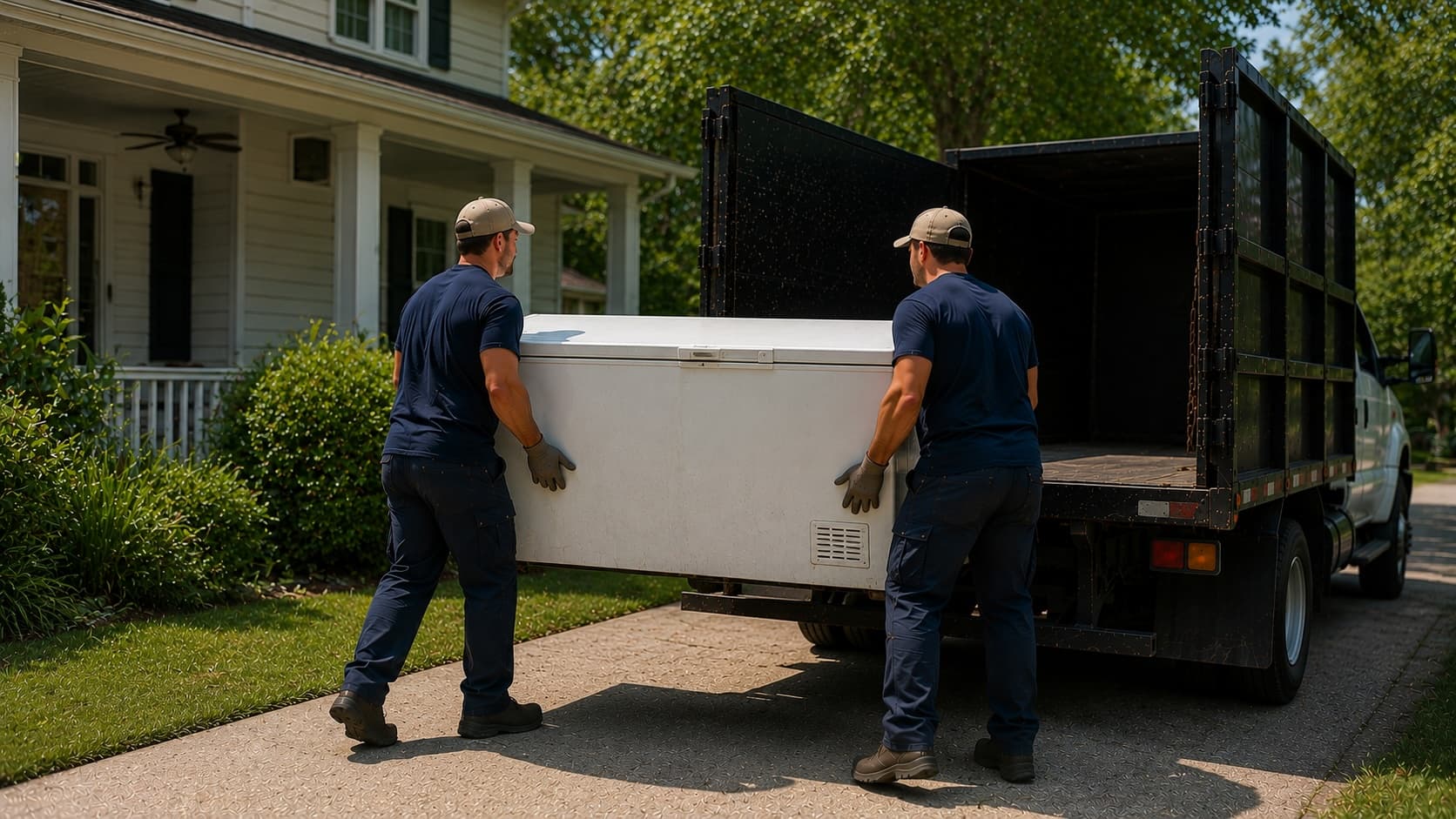
- Two-person carry-out and stair handling
- Scrap-metal recycling after refrigerant recovery
- How pricing works
- What drives the price is whether it’s a chest or upright and the carry — a full chest freezer is bottom-heavy and awkward up a basement stair, a mini is quick. Refrigerant recovery happens at the recycler after pickup, not as a line item on your bill. We give the number before we touch the unit.
Part of our Appliance Removal service
Freezer removal carries the same constraint refrigerator removal does. Refrigerant — usually R-134a or R-410a in newer units, R-22 in pre-2010 units — has to be recovered before the unit is disposed of, and that recovery is not something a hauling crew does. So the decision that matters is where the freezer goes: ours go to SA Recycling in Brunswick, which handles that recovery as part of its appliance-recycling process. Recognizing that a freezer needs that destination rather than an ordinary load is the expertise here.
Most freezer calls are homeowners with a chest or upright freezer in the garage that finally stopped working. The compressor seized, the thermostat failed, the unit is twenty years old and isn’t worth repairing. Sometimes the freezer was a backup unit that nobody emptied after a power outage and now it’s full of spoiled food the customer doesn’t want to deal with. Sometimes it’s an estate cleanout where the freezer was forgotten in a shed or a garage corner — sometimes still running, sometimes long dead.
Operationally, chest freezers and upright freezers are different jobs. Chest freezers are low and wide, two-person carry by the side handles, awkward on stairs because the weight is centered low. Upright freezers are tall and narrow, two-person carry on a dolly, easier on stairs. Both are heavier than they look — a full-size chest freezer empty weighs around 150 pounds; an upright commercial-grade freezer can push past 300.
The one every hauler in this trade has a story about is the chest freezer that lost power weeks ago and stayed shut through a Georgia summer. There is nothing else that smells like it, and opening it accomplishes nothing except putting the contents into the air of your garage. So often we don’t. We tape the lid shut and move the whole sealed unit out as one piece, contents and all, and let the disposal facility handle it in the open air with a hose nearby. That isn’t us cutting a corner — it’s the version of the job that leaves the least of it behind in your house. If a unit needs to travel sealed, we’ll tell you that’s the plan before we touch it.
If the freezer is full of spoiled food, we charge for the food disposal as a separate cost driver. It’s not punishment — it’s honesty. Disposing of forty pounds of thawed-out meat costs more than disposing of an empty appliance, and the customer should see that on the estimate rather than discovering it after the fact. Most spoiled-food jobs come from estate cleanouts or post-power-outage scenarios, and we’ve done enough of them that the protocol is routine.
What we haul
Specifically, what we take for freezer removal.
- Chest freezers (5 cu ft to 25 cu ft, residential scale)
- Upright freezers (single-door tall freezers)
- Garage backup freezers (the most common call)
- Mini freezers and dorm-scale units
- Deep freezers (the heavy-duty chest models built for bulk storage)
- Standalone freezers separate from the fridge (no shared cabinet)
- Commercial reach-in freezers from small kitchens (residential-scale, not walk-ins)
- Standalone ice makers (separate from refrigerators)
- Freezers from estate and post-power-outage cleanouts
- Freezers full of spoiled food (with separate food-disposal cost driver)
How we work
How we actually handle it.
Most freezer jobs run thirty to sixty minutes depending on whether the unit is empty or full. Empty freezer is a straight haul — disconnect the power cord, two-person carry by the side handles or onto a dolly, out to the truck. Full freezer adds time for sanitation: we bag the food separately, bag the meltwater, sweep up where the unit was sitting.
We don’t require defrosting before pickup, but if the freezer is full of ice we may ask the customer to plan for water on the floor during transport — the meltwater leaves the seals as the unit tilts. A garage or driveway pickup avoids the floor concern entirely; an indoor pickup from a kitchen or basement gets the protective floor coverings.
Chest freezers on stairs are the hardest version of this job. The weight is centered low and the unit doesn’t articulate well on a dolly. We bring straps and a stair-climber dolly when the call mentions a basement install. Upright freezers handle stairs more like a refrigerator — vertical, dolly-friendly, easier two-person carry.
Pricing
How pricing works.
Freezer pricing scales with size, contents, and access. An empty chest freezer from an accessible garage is the lightest version of this job. A full-size upright freezer from a basement, full of spoiled food, in the middle of summer, is the heaviest.
Spoiled food adds a separate disposal cost driver, named on the estimate so the line item is visible. The cost reflects the actual disposal — bagged food waste at landfill rates plus sanitation supplies. Most spoiled-food jobs run reasonably; it’s the visit nobody wants to handle themselves and we don’t mark it up beyond what the work costs.
Refrigerant recovery is included in the appliance price — same as refrigerator pricing. The customer is paying for the freezer to be gone, with the refrigerant handled correctly, with the unit routed through scrap recycling rather than the landfill.
The honest exceptions
What we won’t take — for this item.
A short, honest list of edge cases we either won’t take or want to discuss before we show up. When in doubt, call us — we’ll walk through it before scheduling.
- Walk-in freezers and commercial walk-in cold storage units (require commercial-scale equipment)
- Freezers with active visibly-leaking refrigerant — call us first so we can plan the right protocol
- Active refrigerant work beyond capture for transport — full HVAC recovery requires licensed refrigeration tech
- Freezers stuck in built-in cabinetry requiring carpentry beyond standard appliance disconnect
Questions
Frequently asked questions about freezer removal.
Related items
Other things people pair with this haul.
Refrigerator Removal
Refrigerator removal routes the unit to an appliance recycler that handles refrigerant recovery on its end — you don’t do anything beforehand.
Read moreDishwasher Removal
Most dishwasher jobs run thirty minutes start to finish.
Read moreStove and Oven Removal
Electric stove removal is straightforward.
Read moreWasher & Dryer Removal
Most washer and dryer jobs start at the wall — water lines disconnected, vent unhooked, then a dolly out.
Read moreAir Conditioner Removal
Window AC units are the simplest version.
Read moreDehumidifier Removal
Most dehumidifier jobs run twenty to forty minutes.
Read more
Common in
Where we haul freezer removal most.
We haul freezer removal regularly across the Golden Isles, especially in Brunswick, Kingsland, Darien, Jesup, and St. Simons Island.
Ready when you are
Ready to get it out of your driveway?
Free quote in 60 seconds. Same-day pickup available across the Golden Isles.
Open Mon–Sat 7:30am–10pm · Sunday 9am–7pm
Last reviewed: April 27, 2026