Appliance
Dryer removal across the Golden Isles.
Standalone dryer pickups, stacked tower unstacks, vent-hose disconnects. The dryer fails first; the washer keeps running. We handle just-the-dryer without making the customer haul the working washer too.
The short version
Dryer Removal at a glance.
- What it is
- Removal and recycling of clothes dryers — electric and gas — hauled once disconnected and routed to scrap-metal recyclers after pickup.
- What’s included
- Electric and gas dryers
- Stacked and compact units
- Vent disconnect at the unit
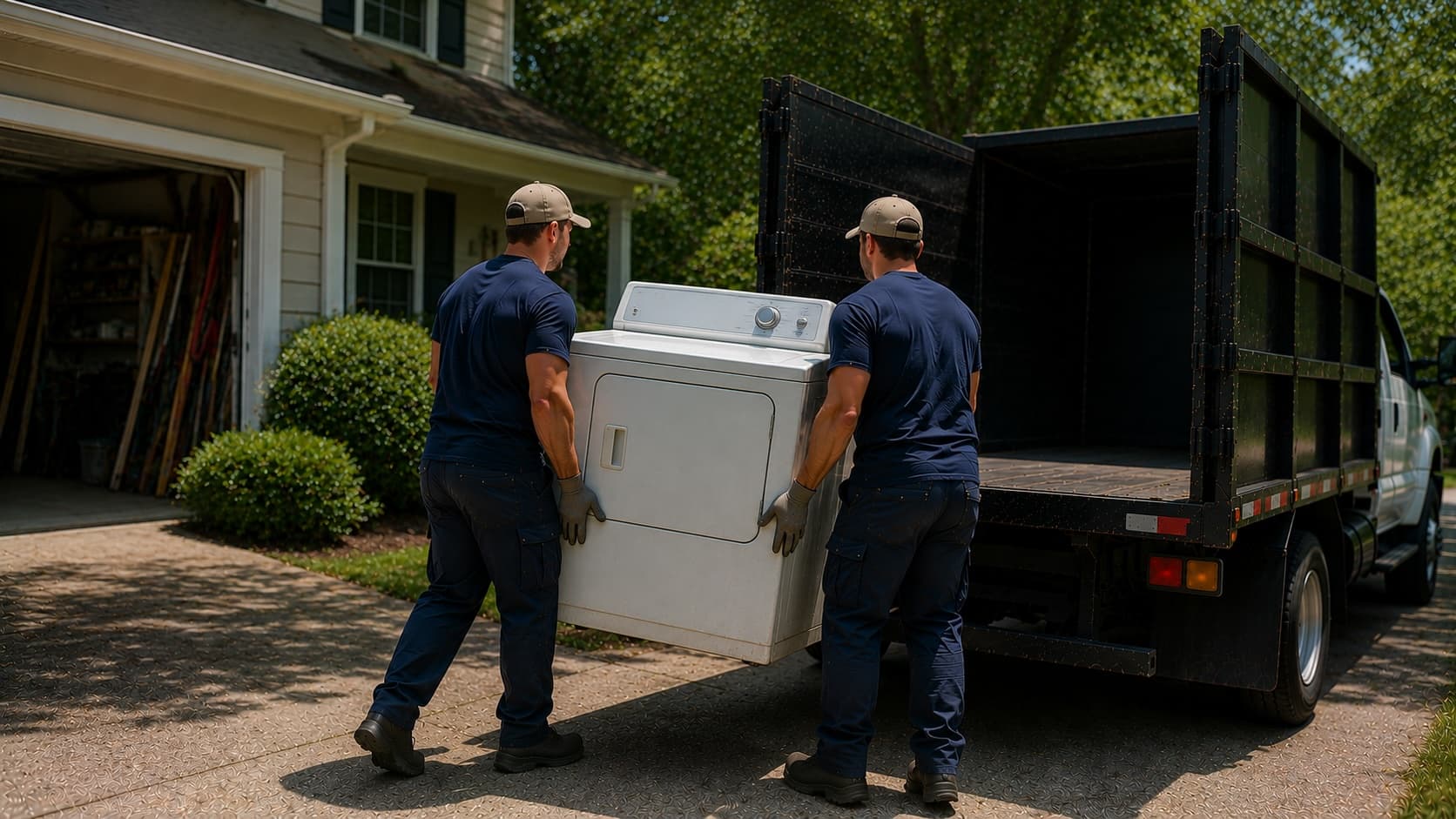
- Two-person carry-out and stair handling
- Scrap-metal recycling routing
- How pricing works
- Priced by unit, access, and floor. Plug-in units we unplug; a gas dryer’s gas line and any hardwired electrical are disconnected by you or a licensed trade first. Quoted before we touch the unit.
Part of our Appliance Removal service
Dryers fail more often than washers. We see this constantly across Brunswick, the islands, and Camden County. The heating element burns out, the motor seizes, the drum bearing wears through and the unit starts squealing — any of those failures will retire a dryer before its paired washer is ready to leave. The customer keeps the working washer and replaces just the dryer. The standalone-dryer-removal call is a real category, distinct from washer-and-dryer combo pickups.
The most common call is exactly that scenario: dryer dies first, customer replaces just the dryer. Estate cleanouts produce dryer-only pickups too — sometimes the washer was donated to a family member while the failed dryer needs disposal. Stacked washer-dryer towers (apartment-style or condo setups) sometimes need just the dryer half removed when the washer is still working; we handle the unstack and the standalone removal in one visit. Pre-listing cleanouts where a broken dryer in the laundry room is hurting the listing photos.
Operationally, dryer removal mirrors washer removal in most respects but with two distinct considerations. First: gas vs electric. Electric dryers (the standard) plug into a 240-volt dedicated outlet — we pull the plug and the unit is disconnected. Gas dryers (more common in newer builds and some older Brunswick homes) have a flexible gas supply line plus the 120-volt outlet for the controls and ignition; the gas line must be capped and made safe by the customer or a licensed plumber or gas professional before we arrive — we don’t cap or modify gas lines. Once the gas side is handled, we take care of the vent hose and the haul. Second: stacked towers. Apartment-style stacked washer-dryer units (the dryer mounted directly above the washer) need an unstack step before standalone removal. Two-person lift to separate the units, then the dryer ships out as a regular standalone pickup.
We see standalone dryer failures more often than standalone washer failures. We’ve handled this scenario hundreds of times. For electric dryers, we unplug the 240-volt cord, disconnect the venting hose, and handle the unstack on a tower configuration. For gas dryers, the gas line needs to be capped and made safe by the customer or a licensed gas pro first; from there we handle the vent hose, the unstack, and the haul. Carry the dryer to the truck, route it through scrap recycling at one of the recyclers we work with in Brunswick or Jesup, and the customer’s laundry room is ready for the new dryer.
What we haul
Specifically, what we take for dryer removal.
- Standard electric dryers (240-volt plug, vented configurations)
- Gas dryers (gas line capped by your plumber or gas pro first)
- High-efficiency dryers (heat-pump and condenser-style)
- Stacked washer-dryer towers (with unstack step)
- Front-load and top-load dryers
- Compact and apartment-size dryers (24-inch and stackable)
- Commercial and laundromat-grade dryers (residential-scale, not industrial)
- Failed dryers (heating element, motor, drum bearing failures)
- Storm-damaged dryers from flooded laundry rooms
- Dryers from rental property turnovers
How we work
How we actually handle it.
Most dryer-only jobs run thirty to forty-five minutes. Electric dryers are the fast version: we pull the 240-volt plug from the wall, disconnect the venting hose from the back, and the unit is ready for the carry. For gas dryers, the gas line should already be capped and made safe by the customer or a licensed plumber or gas pro before we arrive — we confirm it’s disconnected and safe, then handle the vent hose and the haul. We don’t cap or modify gas lines ourselves.
Venting hose handling matters. The flexible aluminum or rigid steel duct runs from the back of the dryer to the wall vent; we disconnect at the appliance side, leaving the wall portion intact for the next dryer. Lint accumulates inside the hose over time and sometimes spills during disconnection — we sweep up the lint trail before the carry-out.
Stacked washer-dryer tower removal adds the unstack step. The dryer mounts to the washer with a brace kit (manufacturer-specific) — two or four screws or bolts release the brace, then a two-person lift separates the dryer from the washer. The washer stays in place if it’s still working; the dryer ships out as a standalone removal. Adds maybe fifteen minutes to the visit.
Pricing
How pricing works.
Dryer pricing scales with type, configuration, and access. A standard electric dryer from a ground-floor laundry room is the lightest version. A gas dryer from a stacked tower in a third-floor laundry closet is the heaviest. Stacked tower unstack adds time but isn’t a separate line item.
Phone quotes work for dryer jobs. Photos help when the dryer is in an unusual configuration (tower, compact apartment-size, commercial-grade) or when the laundry room access is tight. Multi-appliance laundry-room cleanouts (dryer plus washer plus utility sink plus shelving) cost less per piece than single-appliance pickups.
For gas dryers, the gas line needs to be capped and made safe by the customer or a licensed plumber or gas pro before pickup — that’s not work we perform. Once it’s safe, the vent hose and the haul are part of the appliance price.
The honest exceptions
What we won’t take — for this item.
A short, honest list of edge cases we either won’t take or want to discuss before we show up. When in doubt, call us — we’ll walk through it before scheduling.
- Gas-line disconnection or capping — the gas line must be capped and made safe by you or a licensed plumber or gas pro before we haul
- Active electrical work on hardwired dryers beyond unplugging at the appliance — licensed electrician scope for circuit changes
- Dryer repair, parts diagnostics, or salvage of working components for resale
- Industrial laundromat dryers exceeding two-person carry capacity without specialty equipment
Questions
Frequently asked questions about dryer removal.
Related items
Other things people pair with this haul.
Washer & Dryer Removal
Most washer and dryer jobs start at the wall — water lines disconnected, vent unhooked, then a dolly out.
Read moreRefrigerator Removal
Refrigerator removal routes the unit to an appliance recycler that handles refrigerant recovery on its end — you don’t do anything beforehand.
Read moreDishwasher Removal
Most dishwasher jobs run thirty minutes start to finish.
Read moreWater Heater Removal
Water heater removal starts with the prep on the old unit.
Read moreFreezer Removal
Most freezer jobs run thirty to sixty minutes depending on whether the unit is empty or full.
Read moreMicrowave Removal
A countertop unit is a lift and a walk to the truck.
Read more
Common in
Where we haul dryer removal most.
We haul dryer removal regularly across the Golden Isles, especially in Brunswick, St. Simons Island, Kingsland, Jesup, and Jekyll Island.
Ready when you are
Ready to get it out of your driveway?
Free quote in 60 seconds. Same-day pickup available across the Golden Isles.
Open Mon–Sat 7:30am–10pm · Sunday 9am–7pm
Last reviewed: April 27, 2026