Appliance
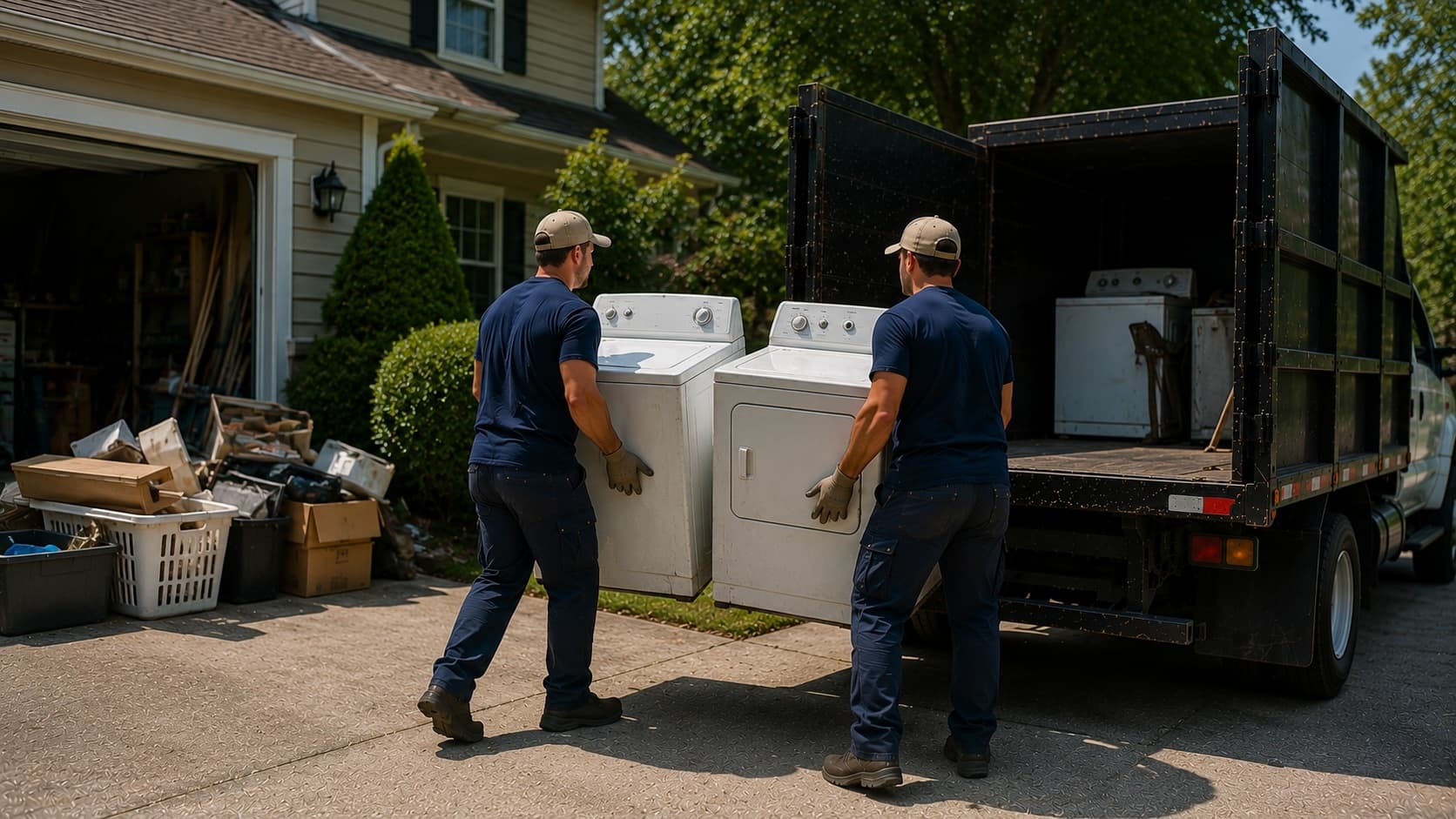
Washer and dryer removal across the Golden Isles.
Top-load, front-load, stackable, HE, gas. Simple disconnects handled, then hauled out cleanly.
The short version
Washer & Dryer Removal at a glance.
- What it is
- Removal and recycling of washing machines and dryers, hauled once disconnected and routed to scrap-metal recyclers after pickup.
- What’s included
- Top-load and front-load washers
- Electric and gas dryers
- Stacked and all-in-one units
- Two-person carry-out and stair handling
- Scrap-metal recycling routing
- How pricing works
- What drives the price is the disconnect and the pair — plug-in units we unplug, but a gas dryer’s gas line and any hardwired electrical are disconnected by you or a licensed trade first, and a stacked or second-floor set runs heavier. We give the number before we touch the unit.
Part of our Appliance Removal service
Washer and dryer removal is the kind of job where the work that matters happens before the lift. Water supply hoses need to be hand-disconnected. Dryer venting needs to come loose without pulling the duct out of the wall.
Gas is where we stop, and we want to be plain about it rather than polite. We do not disconnect gas lines. Not on a dryer, not on a range, not ever. If it’s a gas dryer, the line has to be shut off, disconnected and capped by the gas company or a qualified plumber before we arrive — it’s usually a fifteen-minute call for them. We’ll unplug the electrical and pull the vent hose, and once the gas side is genuinely safe we take the machine from there. Gas leaks kill people. That one isn’t a policy we bend for a quicker booking.
Front-load washers are the surprise on almost every one of these jobs. They’re built with concrete counterweights inside the drum housing to keep the machine from walking across the floor on a spin cycle — fifty to eighty pounds of concrete, sitting on top of the steel drum, the motor and the body. A typical front-loader lands somewhere around 200 to 250 pounds. People watch two grown men strain on a washing machine and say “it’s just a washer.” It’s a washer with a cinder block hidden inside it.
The other thing we ask about on the phone is whether the machine died mid-cycle, because a washer that quit with a full tub is holding thirty or forty gallons — another 250 to 330 pounds of water on top of everything else. We drain it before it moves. Most machines have an emergency drain hose or a filter at the bottom front, and we let gravity do the work into a bucket. If it won’t drain, we tip it carefully toward a floor drain or outside. What we don’t do is carry a washer full of water down a staircase. That’s how somebody gets hurt badly, and no schedule is worth it.
Once the connections are clean, the rest is a two-person carry on a dolly. Most washers and dryers come out the same door they went in, no surprises. Stacked units have to come apart first, which means lifting a 120- to 150-pound dryer down off the top of a washer at chest height — two people, good footing, and a decided-in-advance spot to set it down. Some stacking kits bolt the two together, so those brackets come off before anybody tries to separate them.
What we run into more often than people expect is the disconnection itself — shutoff valves that haven’t been turned in fifteen years sometimes don’t want to move. We’ll work them loose where they’ll go, and there’s always a towel ready because there is residual water in those lines every single time. But if a valve is corroded to the point that closing it means forcing it, we stop and tell you it’s a plumber’s call. Forcing a seized valve to save ourselves a trip is how a laundry room becomes a flood.
What we haul
Specifically, what we take for washer & dryer removal.
- Top-load and front-load washers
- Gas and electric dryers
- Stackable washer/dryer combos
- HE (high-efficiency) machines
- Pedestal-mounted units
- Combination washer/dryer units (single-drum)
- Laundry centers (single-cabinet washer over dryer)
- All-in-one ventless washer-dryer combos
- Storage and riser pedestals (sold separately from the unit)
- Older agitator and direct-drive washers
How we work
How we actually handle it.
Most washer and dryer jobs start at the wall — water lines disconnected, vent unhooked, then a dolly out. Two-person standard. The slow versions are the ones in tight laundry rooms where there’s no room to angle the dolly, or in second-floor laundry rooms where the unit has to come down a stair.
Stackable units come apart at the connecting bracket between the washer and dryer. We separate the two pieces, carry them out individually, and reload as one job. Front-load washers we strap the drum if there’s any chance of the load shifting in transit.
For gas dryers, the gas line has to be capped and made safe by you or a licensed gas pro before we haul — we don’t cap or modify gas lines. We handle the water hoses, the vent, unplugging the unit, and the haul. Tell us on the call if the dryer is gas so we plan around it.
Pricing
How pricing works.
Washer and dryer pricing scales with the unit, the access, and the connections. A standard top-load washer plus electric dryer from a ground-floor laundry is the cheapest version. A stackable in a second-floor closet with a tight doorway is heavier work. Multiple-appliance jobs price as one load rather than separate trips.
We give you the number before we move anything. No surprises on the day.
Ready when you are
Need washer & dryer removal hauled away? We can help.
The honest exceptions
What we won’t take — for this item.
A short, honest list of edge cases we either won’t take or want to discuss before we show up. When in doubt, call us — we’ll walk through it before scheduling.
- Washers or dryers with hazardous-material contamination — call us first
Questions
Frequently asked questions about washer & dryer removal.
Related items
Other things people pair with this haul.
Refrigerator Removal
Refrigerator removal routes the unit to an appliance recycler that handles refrigerant recovery on its end — you don’t do anything beforehand.
Read moreWater Heater Removal
Water heater removal starts with the prep on the old unit.
Read moreDryer Removal
Most dryer-only jobs run thirty to forty-five minutes.
Read moreFreezer Removal
Most freezer jobs run thirty to sixty minutes depending on whether the unit is empty or full.
Read moreStove and Oven Removal
Electric stove removal is straightforward.
Read moreDishwasher Removal
Most dishwasher jobs run thirty minutes start to finish.
Read more
Common in
Where we haul washer & dryer removal most.
We haul washer & dryer removal regularly across the Golden Isles, especially in Brunswick, St. Simons Island, Kingsland, St. Marys, and Jekyll Island.
Ready when you are
Ready to get it out of your driveway?
Free quote in 60 seconds. Same-day pickup available across the Golden Isles.
Open Mon–Sat 7:30am–10pm · Sunday 9am–7pm
Last reviewed: April 26, 2026