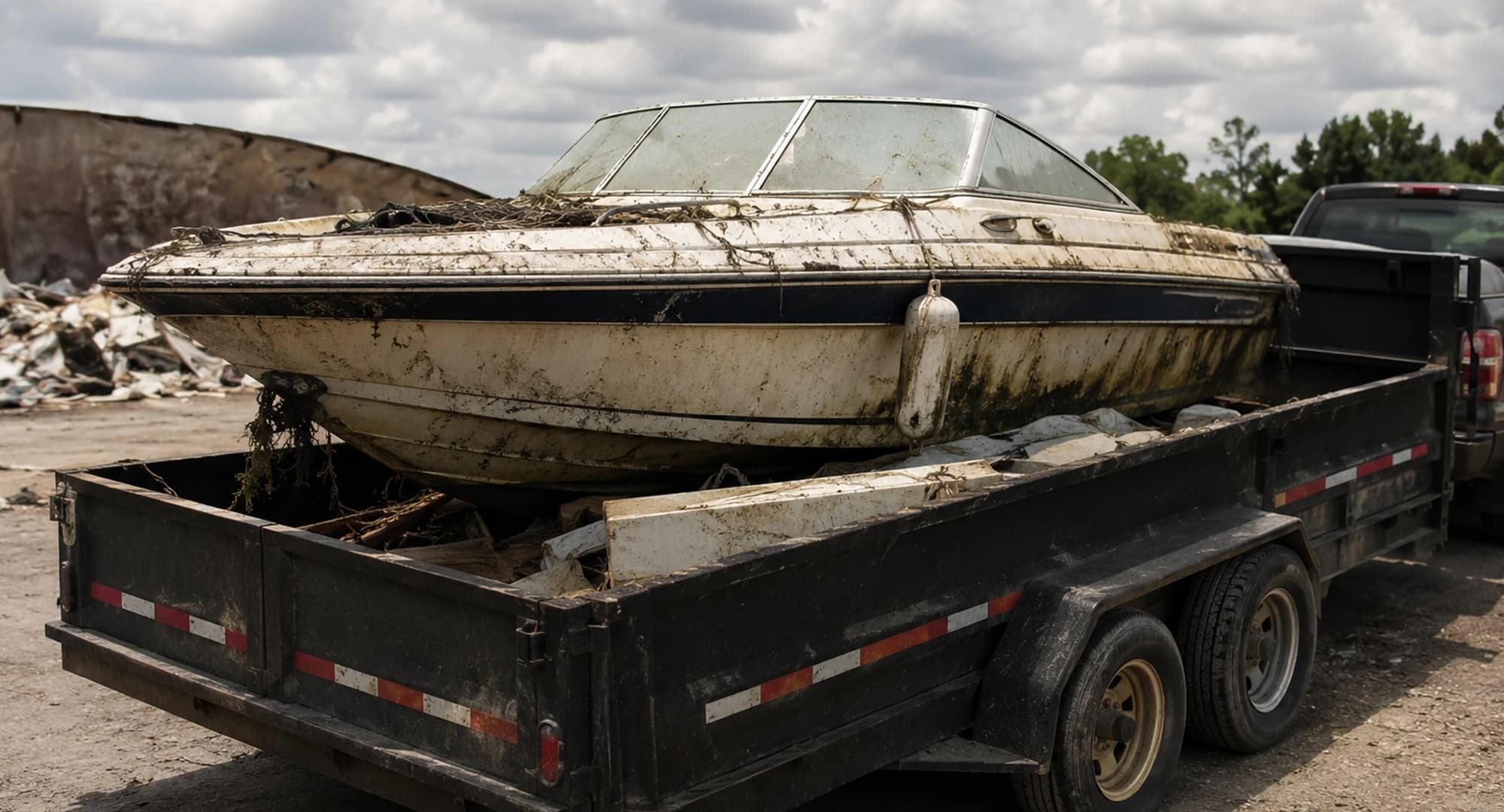
Need an Old Boat Hauled Out of a Brunswick Yard?
Call or Text for the Next Available Boat Removal Opening in Brunswick
Pricing
How pricing works.
What boat removal costs here. We price by the tier your items fill, starting at $95–$150 for a 1/8 truck; a single item is quoted from a photo so we can confirm the tier before anything is loaded. The number you agree to is the number you pay, and it includes carry-out, the disposal fee and cleanup.
Boat pricing comes down to the same four things as any other job — how much there is, the labor to get it out of where it sits, the access, and what it costs to dispose of properly — plus two that are specific to boats: the condition of the hull, and whether it leaves whole or in pieces.
That is why boats are quoted individually rather than off the truck-load table. A boat that has been sitting wet for years does not weigh what its owner remembers, and a tight side yard can matter more than five feet of length. Send us photos or let us come look, and you will get one number, confirmed before anything moves.
The short version
Boat Removal at a glance.
- What it is
- Removal of old boats, personal watercraft, and their trailers from land — hauled out whole where that works, broken down on site where it doesn’t.
- What’s included
- Fiberglass bowriders and runabouts
- Travel trailers, campers, and RVs -- same trailered, titled, heavy-item conversation as a boat
- Aluminum fishing boats and jon boats
- Pontoon boats, decking and all
- Jet Skis and WaveRunners, often in pairs
- Small sailboats and catamarans
- Bass boats and cabin cruisers, evaluated individually
- The trailer too, when you want it gone
- How pricing works
- We price the actual boat, not a chart. How big it is, what condition it’s in, whether we can get equipment near it, and whether it leaves whole or in pieces. A waterlogged hull weighs nothing like the brochure said, so we want to see it — photos or in person — before we give you a number, and you get that number before anything moves.
Part of our Light Demolition service
Most of the boats we take have not moved in years. They sit beside a house, behind a shed, or out at the back of a property under whatever is left of a tarp that blew off five summers ago. By the time somebody calls us, the trailer tires have sunk into the dirt, the transom is soft, the deck gives a little when you step on it, and rainwater and leaves have been collecting in the cockpit long enough that the whole thing has become its own small ecosystem.
Coastal Georgia is hard on boats that sit. Sun, humidity, rain and salt air work on everything at once — upholstery rots, wiring corrodes, gelcoat chalks and crazes, plywood decks drink water, and hardware rusts into place. Add a few seasons of vegetation growing up through the trailer and you learn to look before you reach blindly into a compartment or under a cover. Wasps, ants, spiders and the occasional snake are part of dealing with something that has effectively become part of the backyard.
Weight is the other thing that surprises people. Owners tend to remember what the boat weighed when it was new. A hull whose foam, deck and wood structure have been soaking for years is a genuinely different job from the same model dry, and that difference shows up the moment we try to move it.
Almost every call we get comes after the owner has already run the numbers — repair, storage, a trailer that needs work, an engine that needs more — and decided the boat is worth less than what it would take to save it. That decision is yours. Ours is the part that comes after it.
What we haul
Specifically, what we take for boat removal.
- Fiberglass bowriders and runabouts — the most common call, generally in the sixteen-to-twenty-two-foot range and mass-produced from the 1970s through the 1990s. Bayliner, Sea Ray, Larson, Glastron and the like. These are the tarp-blew-off boats.
- Aluminum fishing boats and jon boats — usually given up on because of hull leaks, corrosion, age, or a trailer that disappeared years ago. The aluminum hull can be separated for metal recycling when that is practical and appropriate.
- Pontoon boats — harder than they look. The deck plywood waterlogs, the marine vinyl deteriorates, the furniture rots, and the whole thing is heavier than anybody expects. The aluminum pontoons themselves may carry scrap value; the rotten decking and furniture still have to be dealt with.
- Jet Skis and WaveRunners — frequently a pair on a dual trailer. The usual story is an older two-stroke with engine trouble, electrical problems, and a sun-cooked hull and interior, where fixing both costs more than the pair is worth.
- Small sailboats — trailer-sailers and daysailers in the fourteen-to-twenty-five-foot range, older fiberglass Catalina and MacGregor types, and small catamarans like Hobie Cats. Rigging, sails and hardware deteriorate and the deck goes soft. Keels, masts, standing rigging and unusual trailer setups make these different from a powerboat.
- Bass boats — older performance fiberglass hulls with soft casting decks, a blown outboard, and gelcoat and interior past the point where restoration pencils out.
- Boats with the motor still on them — outboards, stern drives, and the trailer besides; we look at boat, motor and trailer as one job
- Old boat and personal-watercraft trailers on their own, with no boat on them
- Cabin cruisers and cuddy cabins in the twenty-four-to-thirty-two-foot range — the abandoned-project boats. An engine failed, water got into the cockpit or cabin, mold and interior rot followed, and the cost of storage or a slip stopped making sense. These are substantially larger projects and we look at each one individually.
How we work
Old Boats in Brunswick Yards and Along the Water
Some boats come out whole. We have equipment that lets us pick up and haul a boat in one piece, and when the hull is sound enough and we can get to it, that is the simplest version of the job.
Plenty of them do not come out whole. When the condition of the boat or the access to it rules that out, we break the hull down on site and haul it in pieces. Which way a job goes depends on the boat and on the property, and it is one of the first things we work out when we look at it.
Pontoons deserve their own warning. Waterlogged deck plywood adds real weight, and a pontoon boat that has sat through several wet seasons is not the load anybody pictures from the trailer photo. Personal watercraft usually arrive as a pair on a dual trailer, which is a different footprint from one machine. Sailboats bring keels, masts and rigging into the conversation, and their trailers are often built to a shape that does not behave like a powerboat trailer.
Cabin cruisers and anything unusually large, unusually deteriorated or hard to get to just get a closer look from photos first — a rotten twenty-four-footer sitting where we can get equipment to it can be a simpler job than a nineteen-foot boat trapped behind a house.
A boat takes more planning than a couch call, so we would rather have a few days than none. Good photos and an accessible boat help, and the lead time is what lets us look at condition, access and the trailer situation and make the intact-versus-breakdown call before we are standing in your yard. On the day itself, an accessible sixteen-to-twenty-two-foot runabout that loads essentially whole is straightforward. Cutting down a rotten or waterlogged hull, separating the materials and loading it can take a good part of the day. Access and condition drive that far more than length does.
When a boat comes apart on site, the goal is that the spot looks like a boat was removed, not like a boat was demolished there. We collect the fiberglass, wood, hardware and debris our own work generates and haul it with the boat. One honest note: a hull that has been sitting fifteen years leaves a dead rectangle and sometimes a rut, and taking the boat away doesn’t put the grass back.
We work out the access from your photos and plan around what a photo can’t show: a narrow gate, a septic field, soft ground, irrigation lines, low limbs over the route — mention any of those if you know about them. Known access problems are easy to plan around; the same problems discovered with a truck already in the driveway are what turn a half-day into a bad day.
Around Brunswick, the old boat is as likely to be in a side yard in town as at the water. Out toward Blythe Island or on a waterfront place around the Turtle River area, it may be sitting close to the bank, on soft ground, or behind a house with only one narrow way in — and that, more than its length, decides whether it leaves whole or gets broken down where it sits. Every boat is different. Send us some photos and the location, and we’ll take a look and tell you what it takes. A few days of lead time lets us bring the right equipment, and it’s the same process anywhere on the Brunswick side.
Every boat is different. If it’s still in the water or tied to a dock, send us some photos and the location, and we’ll take a look and tell you what it takes. Hazardous materials — chemicals, solvents, fuel, asbestos-suspect material and the like — need their own route, and we’ll tell you where they go. Whoever books the job just needs the right to dispose of what’s being removed.
Questions
Frequently asked questions about boat removal.
Related items
Other things people pair with this haul.
RV & Travel Trailer Removal
The first thing we want is photographs — the unit, the tongue and coupler, the tires, and enough of the surroundings to see how it comes out.
Read moreScrap Metal Removal
Scrap loading is the routine work — gloves on, gloves stay on.
Read moreShed Disposal
A freestanding, clean backyard shed is the straightforward version of this job.
Read moreRiding Mower Removal
Gas in the tank or a battery on it?
Read moreAbove-Ground Pool Removal
An above-ground pool removal starts with draining, then the panels and liner come off in sequence.
Read moreCrab Trap, Net & Commercial Fishing Gear Removal
Send photos of the pile and where it sits — the yard, the shed, beside the dock — and we’ll give you a firm price for the lot.
Read more
Common in
Where we haul boat removal most.
We haul boat removal regularly across the Golden Isles, especially in Brunswick, St. Simons Island, Darien, St. Marys, Kingsland, and Hinesville.
In this category
Everything in boat & marine junk removal, A to Z.
- Boat Lift & Jet Ski Lift RemovalAlso called: boat lift
- Boat Trailer RemovalAlso called: boat trailer, jet ski trailer, pwc trailer, pontoon trailer, kayak trailer
- Floating Dock & Gangway RemovalAlso called: floating boat dock, aluminum gangway, dock ladder, dock storage cabinet, dock bumper
- Jet Ski & PWC RemovalAlso called: jet ski, personal watercraft, Jet Ski (Kawasaki), Sea-Doo, WaveRunner
- Marine & Boat Equipment RemovalAlso called: marine fuel tank, boat console, boat windshield, fiberglass boat hardtop, boat t-top
- Outboard Motor RemovalAlso called: outboard boat motor, outboard motor, boat engine stand, boat motor storage rack, boat motor
- Pontoon Boat RemovalAlso called: pontoon boat
By town
- Boat Lift & Jet Ski Lift: Darien · St. Simons Island
- Boat Trailer: Darien · St. Simons Island
- Crab Trap, Net & Commercial Fishing Gear: Darien · St. Simons Island
- Floating Dock & Gangway: Darien · St. Simons Island
- Jet Ski & PWC: Darien · St. Simons Island
- Marine & Boat Equipment: Darien · St. Simons Island
- Outboard Motor: Darien · St. Simons Island
- Pontoon Boat: Darien · St. Simons Island
Boat Removal by town: Darien · St. Simons Island
Doing this as part of your job?
We work differently for the pros.
Serving Brunswick and St. Simons Island.
Boat Removal is handled out of our Brunswick base, across Glynn County and the Golden Isles. Call or text for the next available opening.
Ready when you are
Ready to get it out of your driveway?
Get a firm price from photos. Call or text for the next available opening.
Get a free estimate onlineOpen Mon–Sat 7:30am–10pm · Sunday 9am–7pm
Last reviewed: September 2, 2026